Swayambhunath
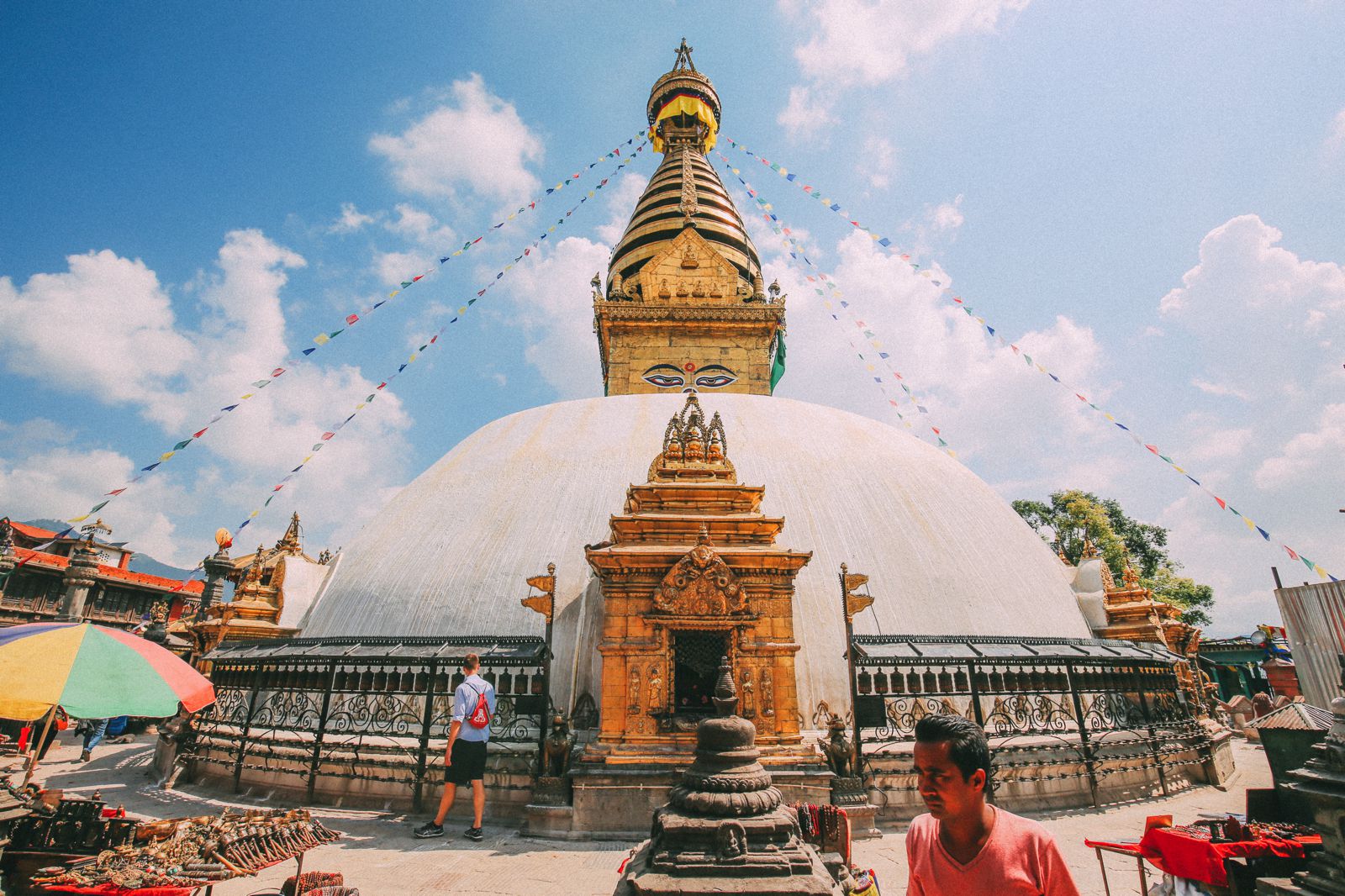
Also known as the "Monkey Temple" among visitors from abroad, Swayambhunath sits atop its hill, overlooking most parts of the valley. This is a good place to catch panoramic views of the city. The site itself has stood as a hallmark of faith and harmony for centuries. The glory of Kathmandu Valley is said to have started from this point. Swayambhunath Lord Buddha
Swayambhunath is one of the holiest Buddhist Chaityas in Nepal. It is said to have evolved spontaneously when the valley was created out of a primordial lake more than 2,000 years ago. This stupa is the oldest of its kind in Nepal and has numerous shrines and monasteries on its premises.
Swayambhu literally means "self-existent one". According to translations from an inscription dating back to 460 A.D., it was built by King Manadeva and by the 13th century, Swayambhunath had developed into an important center of Buddhism.
Legend has it that Swayambhu was born out of a lotus flower that bloomed in the middle of a lake that once spread across the Kathmandu Valley once was. The largest image of the Sakyamuni Buddha in Nepal sits on a pedestal on the western boundary of Swayambhu. Behind the hilltop is a temple dedicated to Manjusri or Saraswati - the Goddess of learning. Chaityas, statues and shrines of Buddhist and Hindu deities fill the stupa complex. The base of the hill is almost entirely surrounded by prayer wheels that were recently installed. Devotees can be seen circumambulating the stupa at all times.
The stupa sits atop the hill and the exceedingly steep stone steps leading up to the shrine is quite a challenge. However, there is also a road going up almost to the top and you can drive up. A large number of Buddhists and Hindus alike visit Swayambhunath through out the day. Swayambhu is perhaps the best place to observe religious harmony in Nepal.
Some important monuments to see in this area
The huge gold plated Vajra ‘thunderbolt’ set in the east side of the stupa
Buddha statue on the west side of Swayambhu
The Sleeping Buddha
The Dewa Dharma Monastery, noted for a bronze icon of Buddha and traditional Tibetan paintings
The temple dedicated to Harati, the goddess of all children. It is said that she was an ogress before Lord Buddha converted her to be the caretaker of all children.
A golden spire crowning a conical wooded hill, Swayambhunath Stupa is the most ancient and enigmatic of all the holy shrines in Kathmandu valley. Its lofty white dome and glittering golden spire are visible for many miles and from all sides of the valley. Historical records found on a stone inscription give evidence that the stupa was already an important Buddhist pilgrimage destination by the 5th century AD. Its origins however, date to a much earlier time, long before the arrival of Buddhism into the valley. A collection of legends about the site, the 15th century Swayambhu Purana, tells of a miraculous lotus, planted by a past Buddha, which blossomed from the lake that once covered Kathmandu valley. The lotus mysteriously radiated a brilliant light, and the name of the place came to be Swayambhu, meaning 'Self-Created or Self-Existent'. Saints, sages and divinities traveled to the lake to venerate this miraculous light for its power in granting enlightenment. During this time, the Bodhisatva Manjushri was meditating at the sacred mountain of Wu Tai Shan and had a vision of the dazzling Swayambhu light. Manjushri flew across the mountains of China and Tibet upon his blue lion to worship the lotus. Deeply impressed by the power of the radiant light, Manjushri felt that if the water were drained out of the lake Swayambhu would become more easily accessible to human pilgrims. With a great sword Manjushri cut a gorge in the mountains surrounding the lake. The water, draining away, left the valley of present day Kathmandu. The lotus was then transformed into a hill and the light became the Swayabhunath Stupa.


No comments:
Post a Comment